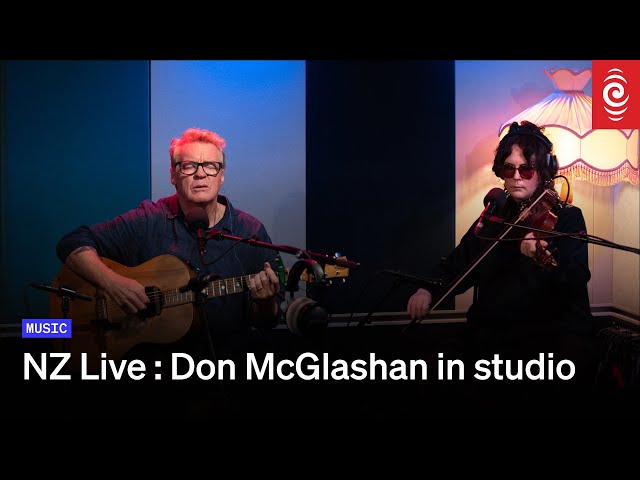
Don McGlashan: 'All we can do is keep our tools sharp'
Iconic New Zealand musician Don McGlashan on music, water and the meaning of life.

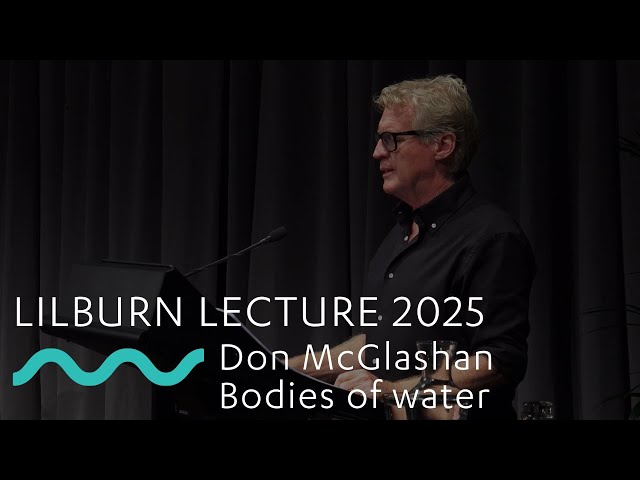
In early November New Zealand music icon Don McGlashan (The Mutton Birds, The Front Lawn, Blam Blam Blam) gave the Lilburn Lecture at Wellington's National Library. Here's an edited version of his words.
I go swimming a lot. Either where I live half of the year, with my lovely wife Ann in Vancouver - in a place called English Bay, or, when I'm back in Auckland, the other half of the year at Point Chevalier or one of the tidal mud-flat bays on the Titirangi shore.
Although I'm a fairly confident swimmer, I always feel fear at that first dive: pushing off, and then coming up, breast-stroking.
The childlike fear of what's underneath; what snag I might hit; what aquatic creature might come up and bite me; what clammy weeds might brush against me. Then pushing through that fear and feeling the joy of moving in a new medium.
All of that, for me, mirrors jumping off into trying to write a new song.The initial fear of coming up with something hackneyed and useless. Then, on a good day, there's the blessed transformation as I realise that I'm moving in a new medium that was threatening before, but is now bearing me along on its own current.
Then there’s water as a metaphor for the subconscious.
C.K. Stead, in, I think,“The New Poetic; Yeats to Eliot”, talks about the subconscious as being where all the good stuff comes from.The clear way we see the world, our own authentic voice. But we have no control over when that good stuff is going to be obliging and come out. All we can do is to keep our tools sharp so that when it does arrive, we can go to work on it effectively.
So we live on the surface, but the subconscious is below us, available to us.
As writers, we tap into the subconscious every time we reach a fork in the road. "Shall I do it this way, or that way?" When we make a choice, and the subconscious agrees, there’s a satisfying click - like the door of an expensive European car closing.
I also sometimes see bodies of water as representing our relationship with time.
The future is like the sky. The past is underwater, and the present is what’s in between: the surface of the sea, the lake, the river; the tiny skin between two vast elements. It’s a cramped space, but that's where we live, sliding along, trying not to capsize. The future is unknowable, unattainable; in the present, we’re too busy to concentrate on anything but our immediate concerns, so, in terms of raw materials, that only leaves us with the past, which is like a lake that's been formed by a hydro scheme. Streets, trees, empty buildings; ghostly, dark, washed by invisible currents. We can dive in there and see what we can find.
Then there's the real sea around us, here in Aotearoa.
Not a metaphor, just a real thing. Very wet, very big. A unimaginable challenge for the brilliant Polynesian navigators who first found these islands, a leap into the unknown for the Pakeha families who were pushed by social injustice at home, and pulled by the false advertising of outfits like the New Zealand Company - and now a barrier between us and the world, keeping us a long way away from everything, while keeping us relatively safe from invaders. So far, anyway.
It has a huge impact on the music industry here. If you’re in a band in Belgium, you can load your gear in a van and drive to many countries. You can’t do that so easily in Aotearoa.
The sea, for New Zealanders, is like Outer Space.
So we have a deep, respectful, existential fear of it - and we should.
Our sense of the emptiness out there should make all of us more acutely aware of the need to look after this country of ours. This raft we’re all clinging to is the only one we’ve got.
But the sea is also something we love. We swim, surf, paddle, dive, fish in it, walk beside it, sail boats on it, pay an arm and a leg to live anywhere near it. But whether we’re playing in it, or just standing, looking at it and wondering, we need it. It’s deep inside us, like the plains are for Albertans, or the mountains for Tibetans. That unlikely combination of a very sensible fear and a paradoxical love makes us who we are.
New islands, new possibilities
I started this talk with the notion of bodies of water being like the subconscious, from which come ideas that we can make into art to help us answer the important questions.
Or like a representation of past, present and future.
Or a metaphor for the fear of the unknown that I feel when I’m starting a new song.
Or the very real, un-metaphorical barrier between Aotearoa and the rest of the world.
There’s another way of looking at bodies of water, though. They’re where Islands can be found.
About 16 years ago, I was showing an overseas musician around Auckland - we were driving around the Eastern Bays to Karaka Bay, a hidden place I go to sometimes when I have a few hours to sit and get my bearings. I was giving my friend a commentary on the Gulf and the islands and how we are shaped by the landscape around us in the choreography of sea and land, and I also talked about Rangitoto and how it suddenly appeared less than 1000 years ago.
I was feeling a bit lost, my marriage was breaking up, and towards the end of the day, I must have said something pessimistic about not being able to see the future and where I fitted into it. And he said, “You never know, though. New islands might appear suddenly without warning”
New islands; new possibilities. You might find them - “simply by sailing in a new direction”, as Allen Curnow said - or they might appear suddenly out of the sea like Rangitoto - violent, rough on your feet, but somehow miraculous.